AI in Healthcare: Revolutionizing Patient Care
TL;DR
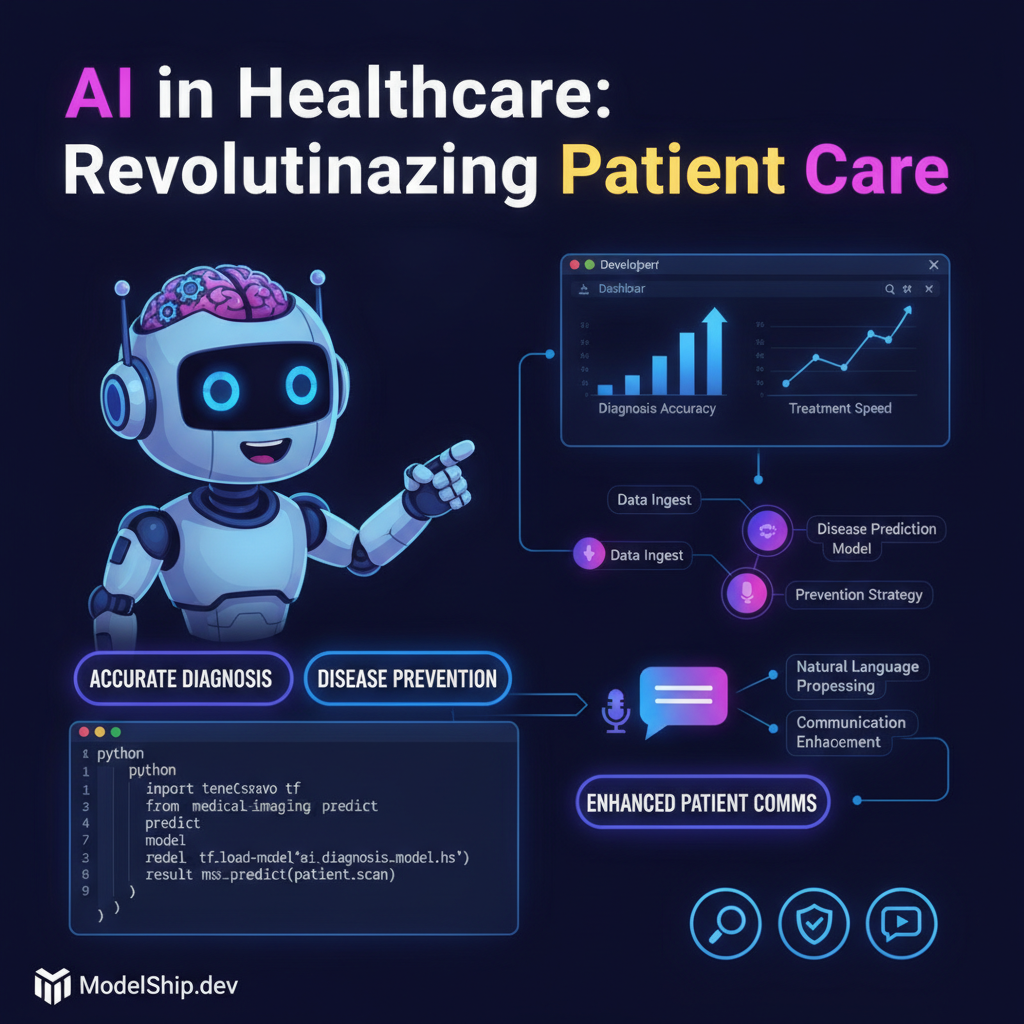
Here's the thing, AI is transforming healthcare as we know it. From diagnosis to treatment, AI is improving patient care and outcomes. In my experience, the key to successful AI adoption in healthcare is understanding the intersection of technology and medicine. Let me show you exactly how I do this, with a focus on practical implementation and real-world examples.
Key Takeaways
- AI can improve diagnosis accuracy and speed
- Machine learning algorithms can be used for disease prediction and prevention
- Natural language processing can enhance patient engagement and communication
- Computer vision can aid in medical imaging analysis
- Explainable AI is crucial for building trust in AI-driven healthcare decisions
How AI is Changing Healthcare
As a senior AI engineer, I've seen firsthand the impact of AI on various industries, and healthcare is no exception. In this article, we'll explore the ways in which AI is revolutionizing patient care and outcomes.
Introduction to AI in Healthcare
In my experience, the key to successful AI adoption in healthcare is understanding the intersection of technology and medicine. This is the part most tutorials skip, but it's essential for building effective AI solutions.
Benefits of AI in Healthcare
Here are just a few examples of how AI is improving healthcare: machine learning can be used for disease prediction and prevention, while explainable AI can help build trust in AI-driven decisions.
Challenges in AI Adoption
However, there are also challenges to consider, such as data quality and regulatory compliance.
Diagnosis and Treatment
Let me show you exactly how I do this, with a focus on practical implementation and real-world examples. For instance, we can use active learning to improve diagnosis accuracy.
AI-Powered Diagnosis
import pandas as pd
from sklearn.ensemble import RandomForestClassifier
from sklearn.model_selection import train_test_split

data = pd.read_csv("patient_data.csv")
X = data.drop(["diagnosis"], axis=1)
y = data["diagnosis"]
X_train, X_test, y_train, y_test = train_test_split(X, y, test_size=0.2)
model = RandomForestClassifier()
model.fit(X_train, y_train)
print(model.score(X_test, y_test))
Treatment and Patient Care
This is where recommendation systems come in, helping to personalize treatment plans for patients.
Patient Engagement and Communication
Natural language processing (NLP) can enhance patient engagement and communication, from chatbots to conversational AI.
Patient Chatbots
import nltk
from nltk.stem import WordNetLemmatizer
lemmatizer = WordNetLemmatizer()
def process_patient_input(input_text):
    tokens = nltk.word_tokenize(input_text)
    tokens = [lemmatizer.lemmatize(token) for token in tokens]
    return tokens
Patient Communication
In my experience, effective patient communication is key to successful treatment outcomes.
Medical Imaging Analysis
Computer vision can aid in medical imaging analysis, from image classification to object detection.
Frequently Asked Questions
What are some common applications of AI in healthcare?
Some common applications of AI in healthcare include diagnosis, treatment, patient engagement, and medical imaging analysis.
How can AI improve patient outcomes?
AI can improve patient outcomes by providing personalized treatment plans, enhancing patient engagement and communication, and aiding in medical imaging analysis.
What are some challenges in AI adoption in healthcare?
Some challenges in AI adoption in healthcare include data quality, regulatory compliance, and bias in AI algorithms. AI ethics is essential for addressing these challenges.
Conclusion
In conclusion, AI is revolutionizing healthcare as we know it. From diagnosis to treatment, AI is improving patient care and outcomes. As a senior AI engineer, I've seen firsthand the impact of AI on healthcare, and I'm excited to see what the future holds.
7 years building production AI systems. I write about the stuff that actually works in the real world — practical code, real architectures, zero fluff.
More from Alex Chen →Discussion
Loading comments…
Leave a comment
Related Articles