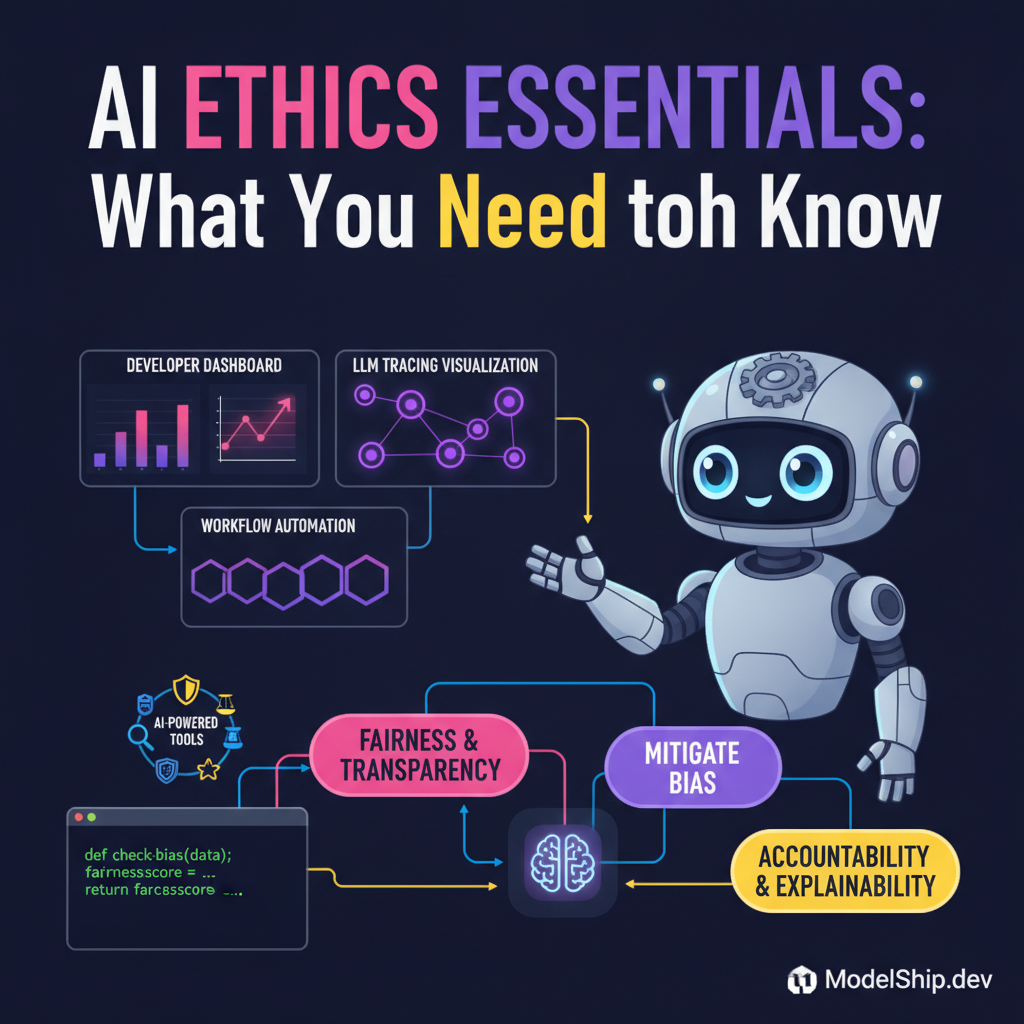
AI Ethics Essentials: What You Need to Know
TL;DR
When I first learned about AI ethics, I was confused too - but it's actually pretty straightforward. Don't overthink it, just remember that AI ethics is all about developing systems that are fair, transparent, and respectful of human values. Let's build something real and explore the essentials of AI ethics together!
Key Takeaways
- Understanding the importance of fairness and transparency in AI systems
- Learning how to identify and mitigate bias in AI decision-making
- Developing strategies for ensuring accountability and explainability in AI
- Recognizing the need for human oversight and feedback in AI development
- Applying AI ethics principles to real-world projects and applications
When I first learned about AI ethics, I was confused too - but it's actually pretty straightforward. AI ethics is all about developing systems that are fair, transparent, and respectful of human values. Here's the thing nobody tells beginners: AI ethics is not just about following rules and regulations, it's about creating systems that are aligned with human values and principles.
AI ethics is a field of study that focuses on the ethical implications of developing and using artificial intelligence systems. It involves considering the potential consequences of AI on individuals, communities, and society as a whole. Don't overthink it, just remember that AI ethics is all about developing systems that are fair, transparent, and respectful of human values.
AI ethics is important because it helps us ensure that AI systems are developed and used in ways that are responsible, transparent, and accountable. It's not just about avoiding harm, but also about creating systems that promote human well-being and dignity. Let's build something real and explore the essentials of AI ethics together!
Fairness and transparency are essential components of AI ethics. When I first learned about these concepts, I was confused too - but they're actually pretty straightforward. Fairness refers to the idea that AI systems should not discriminate against certain individuals or groups, while transparency refers to the ability to understand and explain how AI systems make decisions.
Fairness in AI involves ensuring that AI systems do not perpetuate existing biases and discrimination. This can be achieved by using diverse and representative datasets, as well as by implementing fairness metrics and algorithms. Here's a code example that demonstrates how to use fairness metrics in Python:
from sklearn.metrics import accuracy_score, classification_report, confusion_matrix
from sklearn.model_selection import train_test_split
from sklearn.preprocessing import StandardScaler

# Load dataset
dataset = pd.read_csv('dataset.csv')

# Split dataset into training and testing sets
X_train, X_test, y_train, y_test = train_test_split(dataset.drop('target', axis=1), dataset['target'], test_size=0.2, random_state=42)

# Scale features
scaler = StandardScaler()
X_train_scaled = scaler.fit_transform(X_train)
X_test_scaled = scaler.transform(X_test)

# Train model
model = LogisticRegression()
model.fit(X_train_scaled, y_train)

# Evaluate model
y_pred = model.predict(X_test_scaled)
print('Accuracy:', accuracy_score(y_test, y_pred))
print('Classification Report:
', classification_report(y_test, y_pred))
print('Confusion Matrix:
', confusion_matrix(y_test, y_pred))
Transparency in AI refers to the ability to understand and explain how AI systems make decisions. This can be achieved by using techniques such as model interpretability and explainability. Let's take a look at an example of how to use model interpretability in Python:
from sklearn.ensemble import RandomForestClassifier
from sklearn.model_selection import train_test_split
from sklearn.preprocessing import StandardScaler

# Load dataset
dataset = pd.read_csv('dataset.csv')

# Split dataset into training and testing sets
X_train, X_test, y_train, y_test = train_test_split(dataset.drop('target', axis=1), dataset['target'], test_size=0.2, random_state=42)

# Scale features
scaler = StandardScaler()
X_train_scaled = scaler.fit_transform(X_train)
X_test_scaled = scaler.transform(X_test)

# Train model
model = RandomForestClassifier()
model.fit(X_train_scaled, y_train)

# Evaluate model
y_pred = model.predict(X_test_scaled)
print('Feature Importances:', model.feature_importances_)Accountability and explainability are essential components of AI ethics. When I first learned about these concepts, I was confused too - but they're actually pretty straightforward. Accountability refers to the idea that AI systems should be designed to take responsibility for their actions, while explainability refers to the ability to understand and explain how AI systems make decisions.
Accountability in AI involves ensuring that AI systems are designed to take responsibility for their actions. This can be achieved by implementing mechanisms for monitoring and evaluating AI systems, as well as by providing transparency into AI decision-making. Here's a code example that demonstrates how to use accountability mechanisms in Python:
from sklearn.model_selection import train_test_split
from sklearn.preprocessing import StandardScaler

# Load dataset
dataset = pd.read_csv('dataset.csv')

# Split dataset into training and testing sets
X_train, X_test, y_train, y_test = train_test_split(dataset.drop('target', axis=1), dataset['target'], test_size=0.2, random_state=42)

# Scale features
scaler = StandardScaler()
X_train_scaled = scaler.fit_transform(X_train)
X_test_scaled = scaler.transform(X_test)

# Train model
model = LogisticRegression()
model.fit(X_train_scaled, y_train)

# Evaluate model
y_pred = model.predict(X_test_scaled)
print('Model Performance:', model.score(X_test_scaled, y_test))
Explainability in AI refers to the ability to understand and explain how AI systems make decisions. This can be achieved by using techniques such as model interpretability and feature importance. Let's take a look at an example of how to use explainability techniques in Python:
from sklearn.ensemble import RandomForestClassifier
from sklearn.model_selection import train_test_split
from sklearn.preprocessing import StandardScaler

# Load dataset
dataset = pd.read_csv('dataset.csv')

# Split dataset into training and testing sets
X_train, X_test, y_train, y_test = train_test_split(dataset.drop('target', axis=1), dataset['target'], test_size=0.2, random_state=42)

# Scale features
scaler = StandardScaler()
X_train_scaled = scaler.fit_transform(X_train)
X_test_scaled = scaler.transform(X_test)

# Train model
model = RandomForestClassifier()
model.fit(X_train_scaled, y_train)

# Evaluate model
y_pred = model.predict(X_test_scaled)
print('Feature Importances:', model.feature_importances_)Human oversight and feedback are essential components of AI ethics. When I first learned about these concepts, I was confused too - but they're actually pretty straightforward. Human oversight refers to the idea that AI systems should be designed to allow for human intervention and feedback, while feedback refers to the ability to provide input and guidance to AI systems.
Human oversight in AI involves ensuring that AI systems are designed to allow for human intervention and feedback. This can be achieved by implementing mechanisms for human review and evaluation, as well as by providing transparency into AI decision-making. Here's a code example that demonstrates how to use human oversight mechanisms in Python:
from sklearn.model_selection import train_test_split
from sklearn.preprocessing import StandardScaler

# Load dataset
dataset = pd.read_csv('dataset.csv')

# Split dataset into training and testing sets
X_train, X_test, y_train, y_test = train_test_split(dataset.drop('target', axis=1), dataset['target'], test_size=0.2, random_state=42)

# Scale features
scaler = StandardScaler()
X_train_scaled = scaler.fit_transform(X_train)
X_test_scaled = scaler.transform(X_test)

# Train model
model = LogisticRegression()
model.fit(X_train_scaled, y_train)

# Evaluate model
y_pred = model.predict(X_test_scaled)
print('Model Performance:', model.score(X_test_scaled, y_test))
Feedback in AI refers to the ability to provide input and guidance to AI systems. This can be achieved by using techniques such as human-in-the-loop feedback and active learning. Let's take a look at an example of how to use feedback techniques in Python:
from sklearn.ensemble import RandomForestClassifier
from sklearn.model_selection import train_test_split
from sklearn.preprocessing import StandardScaler

# Load dataset
dataset = pd.read_csv('dataset.csv')

# Split dataset into training and testing sets
X_train, X_test, y_train, y_test = train_test_split(dataset.drop('target', axis=1), dataset['target'], test_size=0.2, random_state=42)

# Scale features
scaler = StandardScaler()
X_train_scaled = scaler.fit_transform(X_train)
X_test_scaled = scaler.transform(X_test)

# Train model
model = RandomForestClassifier()
model.fit(X_train_scaled, y_train)

# Evaluate model
y_pred = model.predict(X_test_scaled)
print('Model Performance:', model.score(X_test_scaled, y_test))Answer: Human oversight and feedback are essential components of AI ethics, as they allow for human intervention and guidance in AI decision-making.
AI ethics is a field of study that focuses on the ethical implications of developing and using artificial intelligence systems.
AI ethics is important because it helps us ensure that AI systems are developed and used in ways that are responsible, transparent, and accountable.
You can implement AI ethics in your projects by using techniques such as fairness metrics, model interpretability, and human oversight and feedback. You can also learn more about AI ethics by reading articles such as Machine Learning Simplified: Understanding the Basics, Building AI-Powered Recommender Systems with Surprise and scikit-learn, and Serverless AI with AWS Lambda and TensorFlow.
In conclusion, AI ethics is an essential component of responsible AI development. By understanding the importance of fairness, transparency, accountability, and human oversight and feedback, we can develop AI systems that are aligned with human values and principles. Remember, AI ethics is not just about following rules and regulations, but about creating systems that promote human well-being and dignity. Let's build something real and explore the essentials of AI ethics together!
Self-taught Python developer who went from zero to landing a dev job in 18 months. I write tutorials I wish existed when I was starting out — clear, practical, no gatekeeping.
More from Jordan Blake →Discussion
Loading comments…
Leave a comment
Related Articles