Using Protocol Buffers for AI API Communication
TL;DR
As an AI engineer, efficient communication between services is crucial. Protocol Buffers offer a robust solution for serializing and deserializing data. In this tutorial, we'll dive into the world of Protocol Buffers and explore how to leverage them for AI API communication. We'll cover the basics, implementation details, and best practices for using Protocol Buffers in production-grade AI engineering. By the end of this tutorial, you'll be equipped with the knowledge to design and implement scalable AI APIs using Protocol Buffers.
Key Takeaways
- Understand the basics of Protocol Buffers and their role in AI API communication
- Learn how to define and implement Protocol Buffer messages for AI data serialization
- Discover how to use Protocol Buffers for efficient data transfer between AI services
- Explore best practices for using Protocol Buffers in production-grade AI engineering
- Implement Protocol Buffers in a real-world AI API communication scenario
Introduction to Protocol Buffers
Protocol Buffers, also known as protobuf, are a language-agnostic data serialization format developed by Google. They offer a robust and efficient way to serialize and deserialize data, making them an ideal choice for communication between services in a microservices architecture. The key insight here is that Protocol Buffers provide a flexible and scalable solution for data serialization, allowing developers to define messages and services using a simple and intuitive syntax.
Defining Protocol Buffer Messages
Basic Syntax
Protocol Buffer messages are defined using a simple and intuitive syntax. The basic syntax consists of a series of fields, each with a unique name and data type. What most tutorials miss is that Protocol Buffers support a wide range of data types, including primitive types, enums, and messages.
syntax = "proto3"; message Person { string name = 1; int32 age = 2; }Advanced Concepts
Protocol Buffers also support advanced concepts like nested messages, repeated fields, and extensions. Let's break this down step by step: nested messages allow developers to define complex data structures, while repeated fields enable the definition of arrays and lists. Extensions, on the other hand, provide a way to add new fields to existing messages without breaking backwards compatibility.
Implementing Protocol Buffer Services
Service Definition
Once you've defined your Protocol Buffer messages, you can implement services using the Protocol Buffer syntax. The key insight here is that services define a set of methods that can be used to interact with the service. What most tutorials miss is that services can be defined using a simple and intuitive syntax, similar to message definitions.
service Greeter { rpc SayHello (HelloRequest) returns (HelloResponse) {} }Service Implementation
Service implementation involves writing code that handles incoming requests and returns responses. Let's break this down step by step: developers can use a variety of programming languages, including Java, Python, and C++, to implement services. Here's why this matters: the choice of programming language will depend on the specific requirements of your project.
Using Protocol Buffers for AI API Communication
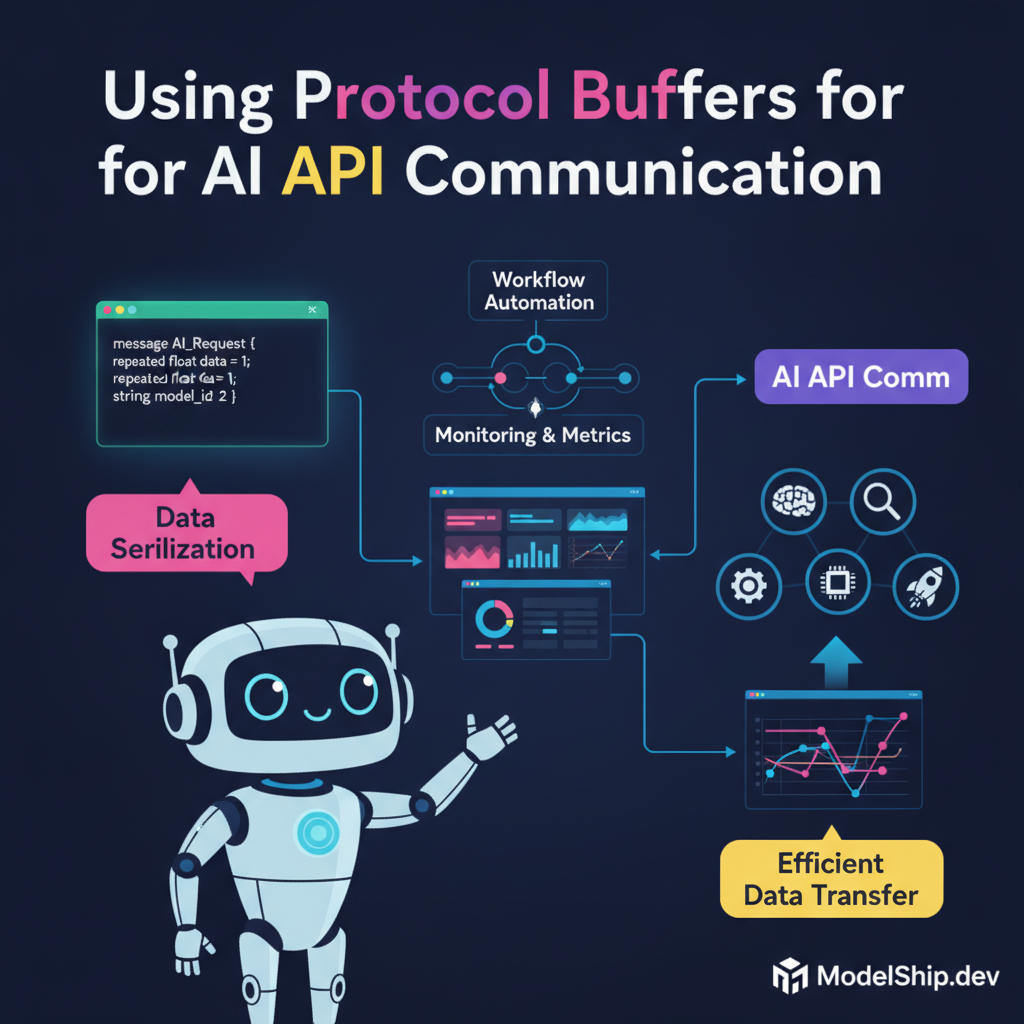
Protocol Buffers can be used to implement efficient AI API communication by serializing and deserializing data using the Protocol Buffer format. The key insight here is that Protocol Buffers provide a robust and scalable solution for data serialization, making them an ideal choice for communication between AI services.
Designing RESTful APIs for AI Models with Flask provides a comprehensive guide to designing and implementing RESTful APIs for AI models. Using GraphQL for AI APIs: Apollo Server Tutorial explores the use of GraphQL for AI API communication. API Gateway for AI Models with AWS API Gateway discusses the role of API gateways in AI API communication.Best Practices for Using Protocol Buffers
When using Protocol Buffers for AI API communication, it's essential to follow best practices to ensure efficient and scalable data serialization. Here's why this matters: following best practices can help prevent common pitfalls and ensure that your AI API communication is robust and reliable.
Frequently Asked Questions
What is the difference between Protocol Buffers and JSON?
Protocol Buffers and JSON are both data serialization formats, but they differ in their approach to data serialization. Protocol Buffers provide a more efficient and scalable solution for data serialization, while JSON is more human-readable and easier to parse.
Can I use Protocol Buffers with other data serialization formats?
Yes, you can use Protocol Buffers with other data serialization formats like JSON and XML. However, it's essential to consider the trade-offs between performance and compatibility when using multiple data serialization formats.
How do I handle errors and exceptions when using Protocol Buffers?
Handling errors and exceptions is crucial when using Protocol Buffers for AI API communication. Developers can use a combination of error handling mechanisms, including try-catch blocks and error codes, to handle exceptions and errors properly.
Conclusion
In conclusion, Protocol Buffers offer a robust and efficient solution for AI API communication and data serialization. By following best practices and using Protocol Buffers effectively, developers can design and implement scalable AI APIs that meet the demands of modern AI applications. Remember, the key insight here is that Protocol Buffers provide a flexible and scalable solution for data serialization, making them an ideal choice for communication between AI services.
PhD in NLP, now building AI products. I explain the 'why' behind AI systems so you can make better engineering decisions, not just copy-paste code.
More from Dr. Sarah Kim →Discussion
Loading comments…
Leave a comment
Related Articles