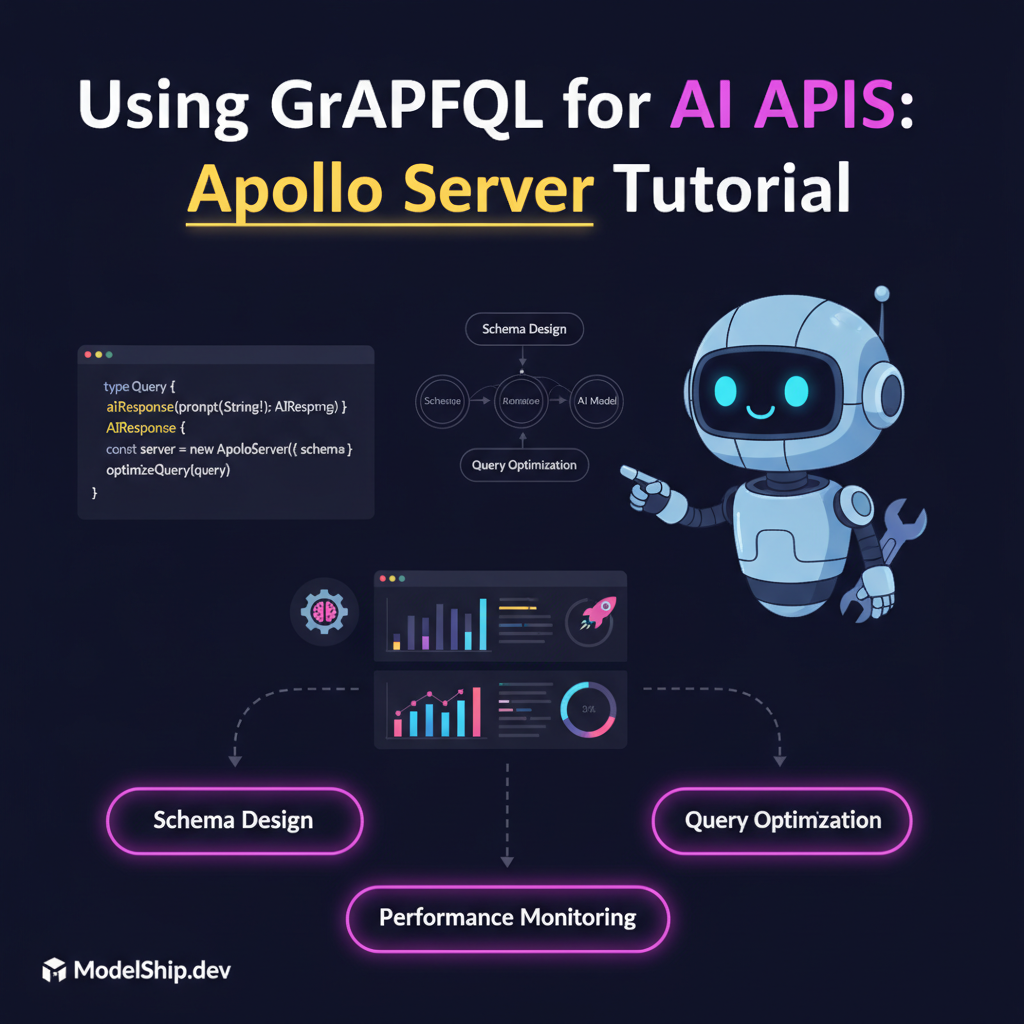
Using GraphQL for AI APIs: Apollo Server Tutorial
TL;DR
In this tutorial, we'll explore the benefits of using GraphQL for AI APIs, including improved query flexibility and reduced overhead. We'll also dive into the implementation details of Apollo Server, covering schema design, resolvers, and query optimization. By the end of this tutorial, you'll have a solid understanding of how to build scalable and efficient AI APIs with GraphQL. Whether you're working with computer vision, natural language processing, or recommender systems, this tutorial will provide you with the practical knowledge you need to take your AI projects to the next level.
Key Takeaways
- Understand the benefits and trade-offs of using GraphQL for AI APIs
- Design and implement a GraphQL schema for AI models using Apollo Server
- Optimize GraphQL queries for improved performance and reduced overhead
- Integrate GraphQL with popular AI frameworks and libraries, such as TensorFlow and PyTorch
- Deploy and monitor GraphQL AI APIs in production environments
Introduction to GraphQL for AI APIs
The key insight here is that GraphQL provides a flexible and efficient way to query AI models, allowing for reduced overhead and improved performance. What most tutorials miss is the importance of schema design and query optimization in achieving these benefits. In this tutorial, we'll explore the fundamentals of GraphQL and Apollo Server, and provide practical guidance on how to build production-grade AI APIs.
Benefits of GraphQL for AI APIs
GraphQL offers several benefits for AI APIs, including improved query flexibility, reduced overhead, and enhanced security. By using GraphQL, you can define a schema that precisely matches the requirements of your AI model, reducing the amount of data that needs to be transferred and processed. This can result in significant performance improvements and cost savings, especially for large-scale AI deployments.
Common Misconceptions about GraphQL
One common misconception about GraphQL is that it's only suitable for simple APIs. However, GraphQL can be used to build complex and scalable APIs, including those that involve machine learning and deep learning. Another misconception is that GraphQL is only useful for client-side development, but it can also be used to build server-side APIs and microservices.
Designing a GraphQL Schema for AI Models
Let's break this down step by step. The first step in designing a GraphQL schema for AI models is to define the types and fields that will be used to represent the data. This includes defining the input types, output types, and any intermediate types that may be required. For example, if you're building a computer vision API, you may define a Image type with fields for width, height, and pixels.
type Image {
  width: Int!
  height: Int!
  pixels: [Float!]!
}
Resolvers and Query Optimization
Once you've defined your schema, you'll need to implement resolvers for each field. Resolvers are functions that retrieve the data for a particular field, and can be used to optimize query performance. For example, you may use a resolver to fetch data from a database or to perform a machine learning inference. Here's why this matters: by optimizing your resolvers, you can reduce the amount of data that needs to be transferred and processed, resulting in improved performance and reduced costs.
Implementing Apollo Server for AI APIs
Apollo Server is a popular GraphQL server that provides a scalable and efficient way to build AI APIs. To get started with Apollo Server, you'll need to install the apollo-server package and define your GraphQL schema. You can then use the ApolloServer class to create a new instance of the server, passing in your schema and any other required options.
const { ApolloServer } = require('apollo-server');
const server = new ApolloServer({
  typeDefs: './schema.graphql',
  resolvers: './resolvers.js',
});
Deploying Apollo Server
Once you've implemented your Apollo Server instance, you'll need to deploy it to a production environment. This can be done using a variety of methods, including containerization with Docker and Kubernetes. Here's a common misconception: many developers assume that deploying a GraphQL API is more complex than deploying a RESTful API. However, with the right tools and techniques, deploying a GraphQL API can be just as straightforward.
Integrating GraphQL with AI Frameworks and Libraries
GraphQL can be used with a variety of AI frameworks and libraries, including TensorFlow and PyTorch. To integrate GraphQL with these frameworks, you'll need to define a schema that matches the requirements of your AI model, and then use resolvers to fetch data from the framework or library. For example, you may define a Prediction type with fields for input, output, and confidence.
type Prediction {
  input: String!
  output: String!
  confidence: Float!
}
Using GraphQL with Deep Q-Networks
GraphQL can be used to build AI APIs that involve deep Q-networks, including those that use PyTorch and Gym. By defining a schema that matches the requirements of your deep Q-network, you can use GraphQL to query the network and retrieve predictions. This can be useful for a variety of applications, including game playing and robotics.
Monitoring and Observability for GraphQL AI APIs
Monitoring and observability are essential for ensuring the performance and reliability of GraphQL AI APIs. To monitor your API, you can use tools such as Prometheus and Grafana. These tools provide real-time insights into API performance, allowing you to identify and fix issues before they become critical.
Common Metrics for GraphQL AI APIs
Some common metrics for GraphQL AI APIs include query latency, error rate, and request throughput. By monitoring these metrics, you can identify areas for improvement and optimize your API for better performance. For example, you may use Prometheus to monitor query latency and identify slow queries that need to be optimized.
Frequently Asked Questions
What is the difference between GraphQL and REST?
GraphQL and REST are both API design paradigms, but they differ in their approach to data retrieval and manipulation. GraphQL provides a flexible and efficient way to query data, while REST provides a more rigid and predefined way to interact with data.
Can I use GraphQL with machine learning frameworks?
Yes, you can use GraphQL with machine learning frameworks such as TensorFlow and PyTorch. By defining a schema that matches the requirements of your machine learning model, you can use GraphQL to query the model and retrieve predictions.
How do I deploy a GraphQL API to production?
To deploy a GraphQL API to production, you'll need to use a combination of tools and techniques, including containerization with Docker and Kubernetes, and monitoring with Prometheus and Grafana. You can also use a serverless function as a backend for your GraphQL API, providing a scalable and efficient way to handle requests.
Conclusion
In conclusion, using GraphQL for AI APIs provides a flexible and efficient way to query data, including machine learning models. By defining a schema that matches the requirements of your AI model, you can use GraphQL to retrieve predictions and improve the performance and reliability of your API. Whether you're working with computer vision, natural language processing, or recommender systems, GraphQL can help you build scalable and efficient AI APIs that meet the needs of your users.
PhD in NLP, now building AI products. I explain the 'why' behind AI systems so you can make better engineering decisions, not just copy-paste code.
More from Dr. Sarah Kim →Discussion
Loading comments…
Leave a comment
Related Articles