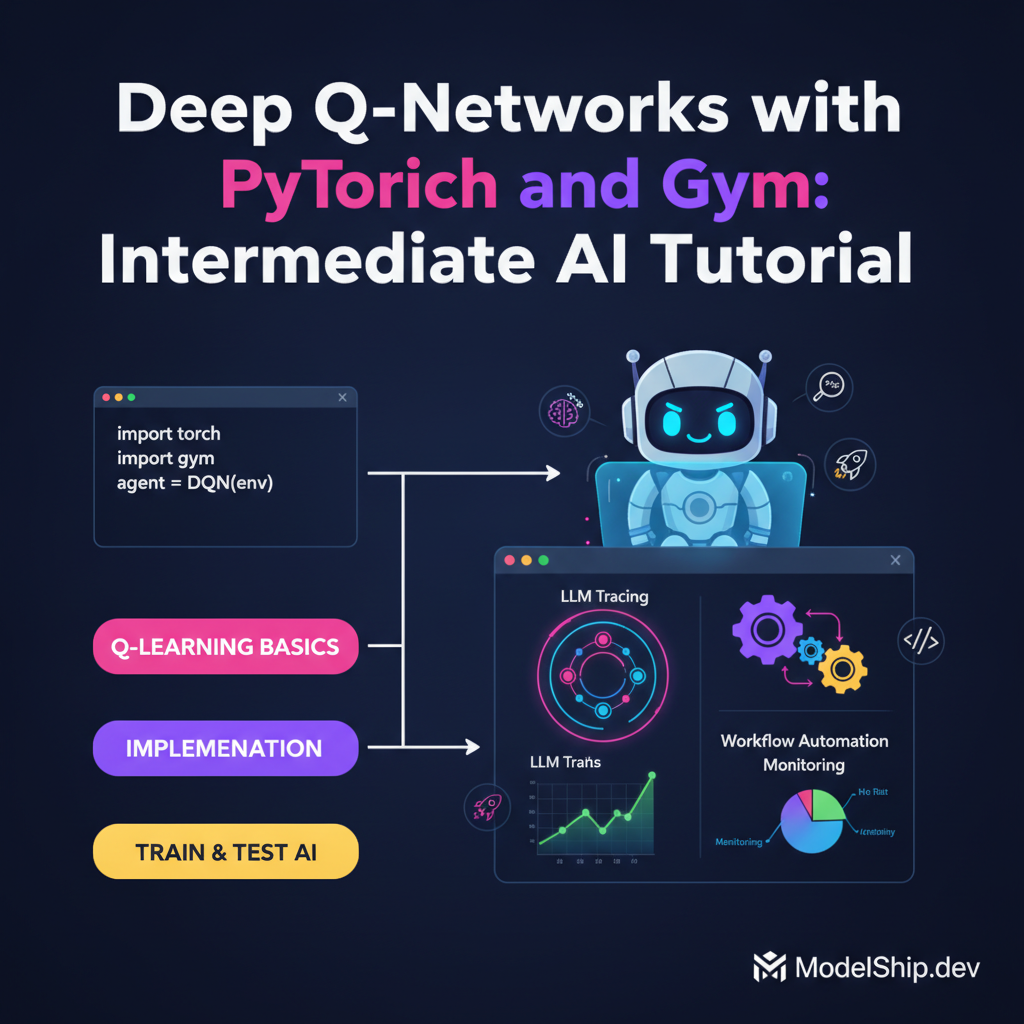
Deep Q-Networks with PyTorch and Gym: Intermediate AI Tutorial
TL;DR
When I first learned about Deep Q-Networks, I was confused too - but with PyTorch and Gym, it's easier than you think. Here's a step-by-step guide to get you started with implementing Deep Q-Networks. Don't overthink it, just follow along and you'll be building your own AI models in no time. We'll cover the basics of Q-Learning, Deep Q-Networks, and how to implement them using PyTorch and Gym.
Key Takeaways
- Understand the basics of Q-Learning and Deep Q-Networks
- Implement Deep Q-Networks using PyTorch and Gym
- Train and test AI models using Q-Learning algorithms
- Use PyTorch and Gym to build and deploy AI models
- Avoid common mistakes and pitfalls when implementing Deep Q-Networks
Introduction to Deep Q-Networks
When I first learned about Deep Q-Networks, I was confused too - but with PyTorch and Gym, it's easier than you think. Here's the thing nobody tells beginners: Deep Q-Networks are just a type of Q-Learning algorithm. Q-Learning is a type of reinforcement learning algorithm that helps AI models learn from their environment and make decisions based on rewards or penalties.
What is Q-Learning?
What are Deep Q-Networks?
Deep Q-Networks are a type of Q-Learning algorithm that uses a neural network to approximate the Q-Table. This allows the AI model to learn from large, complex environments and make decisions based on a wide range of inputs. Deep Q-Networks are often used in game playing AI models, such as those that play Atari games or board games like Go.
Implementing Deep Q-Networks with PyTorch and Gym
Now that we've covered the basics of Q-Learning and Deep Q-Networks, let's implement a Deep Q-Network using PyTorch and Gym. Here's the thing: it's not as hard as you think. Just copy this code exactly:
import gym
import torch
import torch.nn as nn
import torch.optim as optim
Defining the Q-Network
The Q-Network is the neural network that approximates the Q-Table. It takes the state as input and outputs the expected return for each action. Here's an example of how to define the Q-Network using PyTorch:
class QNetwork(nn.Module):
    def __init__(self, state_dim, action_dim):
        super(QNetwork, self).__init__()
        self.fc1 = nn.Linear(state_dim, 128)
        self.fc2 = nn.Linear(128, 128)
        self.fc3 = nn.Linear(128, action_dim)
    def forward(self, x):
        x = torch.relu(self.fc1(x))
        x = torch.relu(self.fc2(x))
        x = self.fc3(x)
        return x
Training the Q-Network
Once we've defined the Q-Network, we can train it using Q-Learning algorithms. Here's an example of how to train the Q-Network using Gym:
env = gym.make('CartPole-v1')
qnetwork = QNetwork(env.observation_space.shape[0], env.action_space.n)
optimizer = optim.Adam(qnetwork.parameters(), lr=0.001)Testing the Q-Network
Once we've trained the Q-Network, we can test it using Gym. Here's an example of how to test the Q-Network:
state = env.reset()
done = False
while not done:
    action = torch.argmax(qnetwork(torch.tensor(state, dtype=torch.float32)))
    next_state, reward, done, _ = env.step(action)
state = next_statePutting it all Together
Now that we've covered the basics of Q-Learning, Deep Q-Networks, and how to implement them using PyTorch and Gym, let's put it all together. Here's an example of how to implement a Deep Q-Network using PyTorch and Gym:
import gym
import torch
import torch.nn as nn
import torch.optim as optim

class QNetwork(nn.Module):
    def __init__(self, state_dim, action_dim):
        super(QNetwork, self).__init__()
        self.fc1 = nn.Linear(state_dim, 128)
        self.fc2 = nn.Linear(128, 128)
        self.fc3 = nn.Linear(128, action_dim)
    def forward(self, x):
        x = torch.relu(self.fc1(x))
        x = torch.relu(self.fc2(x))
        x = self.fc3(x)
        return x

ev = gym.make('CartPole-v1')
qnetwork = QNetwork(env.observation_space.shape[0], env.action_space.n)
optimizer = optim.Adam(qnetwork.parameters(), lr=0.001)Frequently Asked Questions
What is the difference between Q-Learning and Deep Q-Networks?
Q-Learning is a type of reinforcement learning algorithm that uses a Q-Table to store the expected return for each state-action pair. Deep Q-Networks are a type of Q-Learning algorithm that uses a neural network to approximate the Q-Table.
How do I choose the right hyperparameters for my Deep Q-Network?
Choosing the right hyperparameters for your Deep Q-Network can be tricky. Here's a tip: use a grid search to find the best combination of hyperparameters for your environment. You can also use a scikit-learn to help you tune your hyperparameters.
Can I use Deep Q-Networks for other types of AI models?
Yes, you can use Deep Q-Networks for other types of AI models, such as those that play Atari games or board games like Go. You can also use Deep Q-Networks for multi-agent systems, which involve multiple AI models interacting with each other.
Conclusion
That's it for this tutorial on implementing Deep Q-Networks with PyTorch and Gym. I hope you found it helpful and informative. Remember, the key to success with Deep Q-Networks is to start small and build your way up. Don't be afraid to experiment and try new things - and don't forget to check out our other tutorials, such as Evaluating LLMs with Structured Output and Semantic Similarity and Explainable AI with SHAP and LIME Libraries.
Self-taught Python developer who went from zero to landing a dev job in 18 months. I write tutorials I wish existed when I was starting out — clear, practical, no gatekeeping.
More from Jordan Blake →Discussion
Loading comments…
Leave a comment
Related Articles