Machine Learning Simplified: Understanding the Basics
TL;DR
Machine learning is a subset of artificial intelligence that enables systems to learn from data and make predictions or decisions. The key insight here is that understanding the basics of machine learning is crucial for building effective AI systems. In this article, we will break down the concepts and techniques of machine learning, exploring its applications and common pitfalls to avoid. By the end of this tutorial, you will have a solid foundation in machine learning and be able to apply it to real-world problems
Key Takeaways
- Machine learning is a type of artificial intelligence that allows systems to learn from data and make predictions or decisions
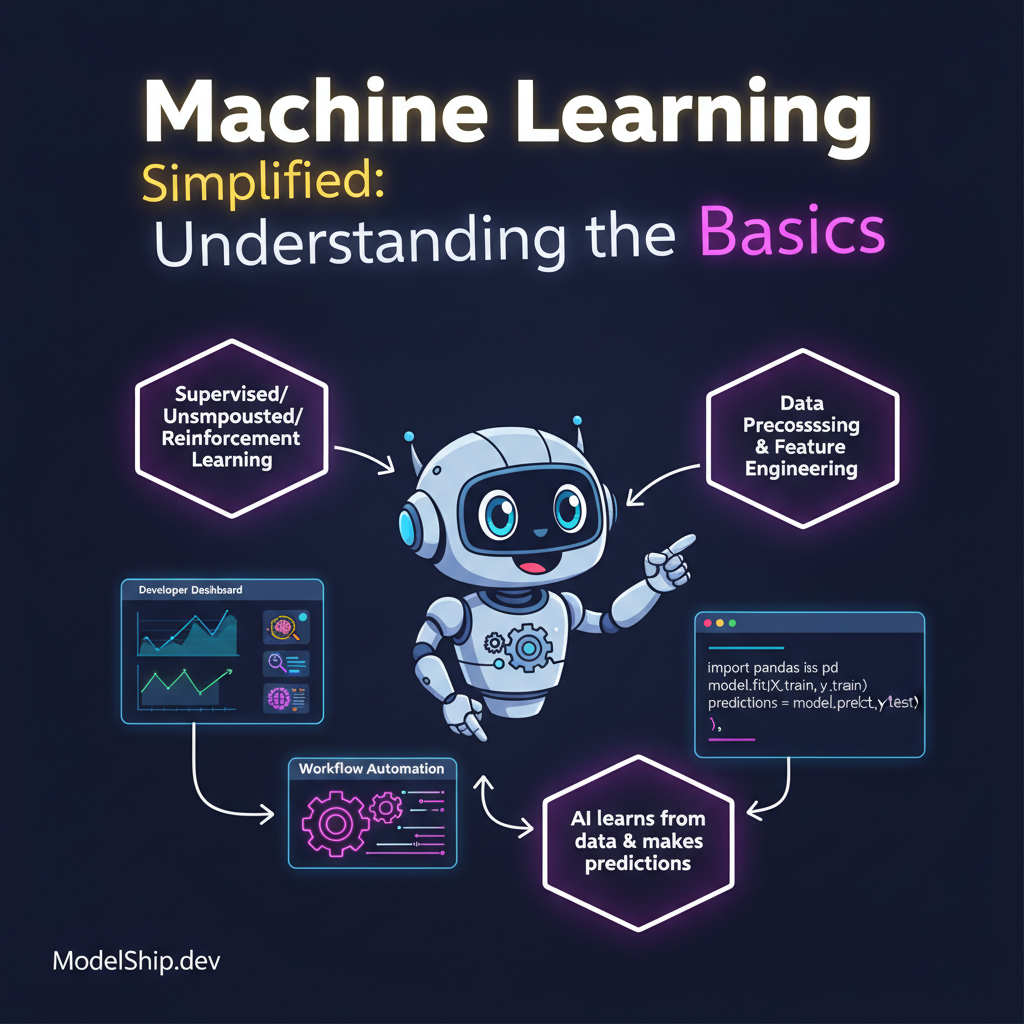
- Supervised, unsupervised, and reinforcement learning are the three main categories of machine learning
- Data preprocessing and feature engineering are critical steps in building effective machine learning models
- Model evaluation and selection are essential for choosing the best model for a given problem
- Machine learning has numerous applications in AI tooling, including natural language processing, computer vision, and recommender systems
Introduction to Machine Learning
Machine learning is a subset of artificial intelligence that enables systems to learn from data and make predictions or decisions. The key insight here is that machine learning is not just about building complex models, but about understanding the underlying principles and techniques that drive these models. What most tutorials miss is that machine learning is a multidisciplinary field that requires knowledge of mathematics, statistics, and computer science.
Types of Machine Learning
There are three main categories of machine learning: supervised, unsupervised, and reinforcement learning. Supervised learning involves training a model on labeled data to make predictions on new, unseen data. Unsupervised learning involves discovering patterns and relationships in unlabeled data. Reinforcement learning involves training a model to take actions in an environment to maximize a reward signal.
Machine Learning Pipeline
A typical machine learning pipeline consists of data collection, data preprocessing, feature engineering, model selection, model training, and model evaluation. Let's break this down step by step: data collection involves gathering data from various sources, data preprocessing involves cleaning and transforming the data, feature engineering involves selecting and transforming the most relevant features, model selection involves choosing the best model for the problem, model training involves training the model on the data, and model evaluation involves assessing the performance of the model.
import pandas as pd
from sklearn.model_selection import train_test_split
from sklearn.linear_model import LinearRegression
from sklearn.metrics import mean_squared_error

data = pd.read_csv('data.csv')
x = data.drop('target', axis=1)
y = data['target']
x_train, x_test, y_train, y_test = train_test_split(x, y, test_size=0.2, random_state=42)
model = LinearRegression()
model.fit(x_train, y_train)
y_pred = model.predict(x_test)
print(mean_squared_error(y_test, y_pred))
Machine Learning Algorithms
There are numerous machine learning algorithms, each with its strengths and weaknesses. Some popular algorithms include linear regression, decision trees, random forests, support vector machines, and neural networks. The key insight here is that choosing the right algorithm depends on the problem, the data, and the desired outcome. What most tutorials miss is that algorithm selection is not a one-size-fits-all solution, but rather a nuanced process that requires careful consideration of the problem and the data.
Supervised Learning Algorithms
Supervised learning algorithms are used for classification and regression tasks. Classification involves predicting a categorical label, while regression involves predicting a continuous value. Some popular supervised learning algorithms include logistic regression, decision trees, and random forests.
Unsupervised Learning Algorithms
Unsupervised learning algorithms are used for clustering, dimensionality reduction, and anomaly detection. Clustering involves grouping similar data points, dimensionality reduction involves reducing the number of features, and anomaly detection involves identifying unusual patterns. Some popular unsupervised learning algorithms include k-means clustering, principal component analysis, and local outlier factor.
import numpy as np
from sklearn.cluster import KMeans

data = np.random.rand(100, 2)
model = KMeans(n_clusters=5)
model.fit(data)
print(model.labels_)
Machine Learning Applications
Machine learning has numerous applications in AI tooling, including multi-agent systems, natural language processing, and distributed training. The key insight here is that machine learning can be used to build intelligent systems that can learn, reason, and interact with their environment. What most tutorials miss is that machine learning applications are not limited to traditional areas like computer vision and robotics, but can be applied to a wide range of domains, including finance, healthcare, and education.
Machine Learning in NLP
Machine learning is widely used in NLP for tasks like text classification, sentiment analysis, and language modeling. Some popular NLP libraries include spaCy and scikit-learn.
Machine Learning in Computer Vision
Machine learning is widely used in computer vision for tasks like image classification, object detection, and segmentation. Some popular computer vision libraries include OpenCV and TensorFlow.
Evaluation and Selection
Evaluation and selection are essential steps in building effective machine learning models. Evaluation involves assessing the performance of a model on a test set, while selection involves choosing the best model for a given problem. The key insight here is that evaluation and selection are not one-time tasks, but rather iterative processes that require careful consideration of the problem, the data, and the desired outcome. What most tutorials miss is that evaluation and selection are not just about metrics like accuracy and precision, but also about understanding the underlying principles and techniques that drive these metrics.
Frequently Asked Questions
What is the Difference Between Machine Learning and Deep Learning?
Machine learning and deep learning are related but distinct concepts. Machine learning involves training models on data to make predictions or decisions, while deep learning involves using neural networks to build complex models.
How Do I Choose the Best Machine Learning Algorithm for My Problem?
Choosing the best machine learning algorithm depends on the problem, the data, and the desired outcome. A practical tip is to start with simple algorithms and gradually move to more complex ones, always evaluating the performance of each algorithm on a validation set.
What Are Some Common Pitfalls to Avoid in Machine Learning?
Some common pitfalls to avoid in machine learning include overfitting, underfitting, and data leakage. Overfitting occurs when a model is too complex and fits the training data too closely, underfitting occurs when a model is too simple and fails to capture the underlying patterns, and data leakage occurs when information from the test set is used to train the model.
Conclusion
In conclusion, machine learning is a powerful tool for building intelligent systems that can learn, reason, and interact with their environment. By understanding the basics of machine learning, including the types of machine learning, the machine learning pipeline, and the various algorithms and applications, you can unlock the full potential of machine learning and build effective AI systems. Remember to always evaluate and select models carefully, and to avoid common pitfalls like overfitting and data leakage. With practice and patience, you can become a proficient machine learning practitioner and build innovative AI systems that can transform industries and improve lives.
PhD in NLP, now building AI products. I explain the 'why' behind AI systems so you can make better engineering decisions, not just copy-paste code.
More from Dr. Sarah Kim →Discussion
Loading comments…
Leave a comment
Related Articles