Reinforcement Learning Agents: Implementation and Optimization
TL;DR
Reinforcement learning agents are a crucial part of AI systems, allowing them to learn from interactions with their environment. Here's the thing, implementing them can be tricky, but with the right tools and techniques, you can create effective agents that optimize their behavior over time. In my experience, it's all about finding the right balance between exploration and exploitation.
Key Takeaways
- Understand the basic components of a reinforcement learning agent
- Learn how to implement a simple reinforcement learning agent using Python and Gym
- Optimize agent performance using techniques like Q-learning and deep reinforcement learning
- Avoid common pitfalls like overfitting and underexploration
- Integrate reinforcement learning agents with other AI systems using tools like <a href="/blog/model-based-reinforcement-learning-for-ai-agents-with-rag">model-based reinforcement learning</a> and <a href="/blog/optimizing-ai-agent-policies-with-reinforcement-learning">policy optimization</a>
Introduction to Reinforcement Learning Agents
Here's the thing, reinforcement learning agents are a type of AI agent that learns from interactions with their environment. They're designed to optimize their behavior over time, maximizing a reward signal that reflects their performance. In this article, we'll dive into the basics of reinforcement learning agents, including their components, implementation, and optimization techniques.
Components of a Reinforcement Learning Agent
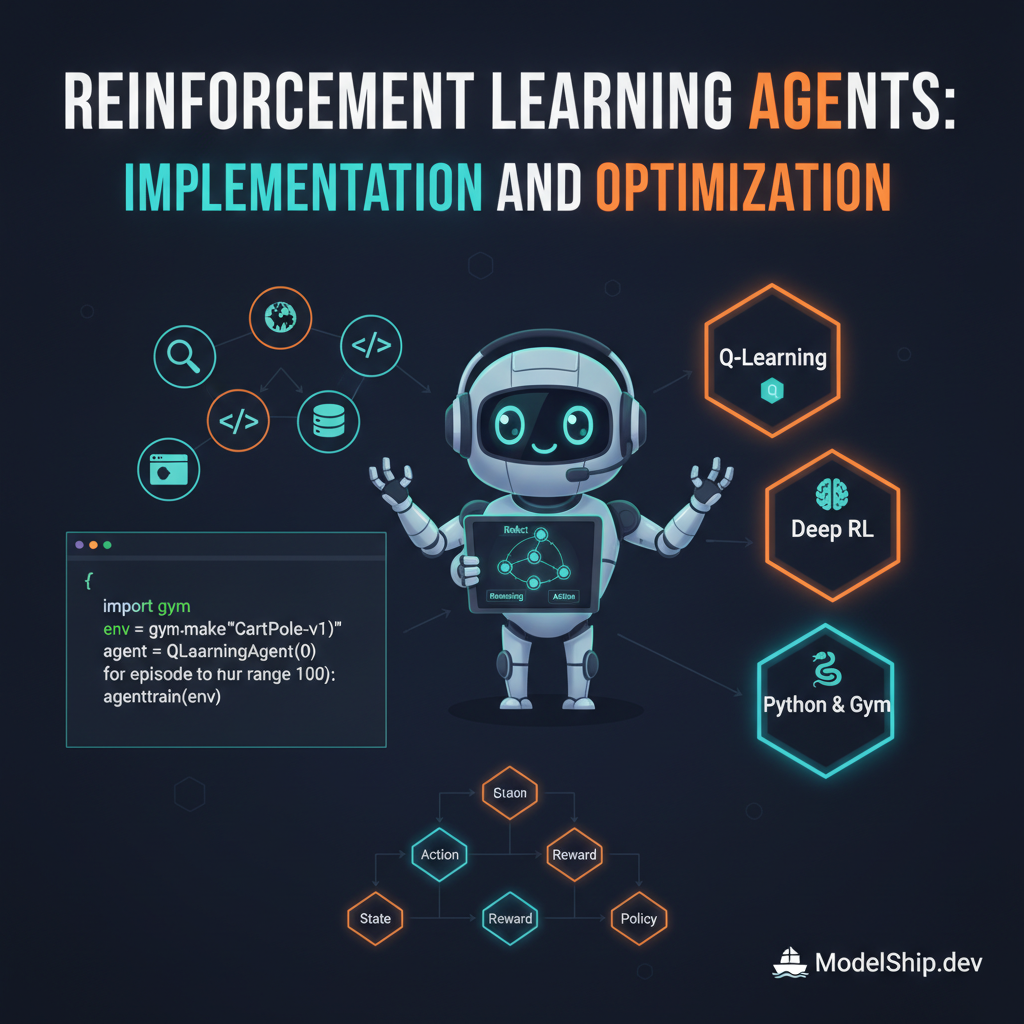
A reinforcement learning agent typically consists of three main components: a policy, a value function, and an environment. The policy determines the agent's actions, the value function estimates the expected return or reward, and the environment provides the context and feedback for the agent's actions.
Implementing a Simple Reinforcement Learning Agent
Let me show you exactly how I do this. Here's an example of a simple reinforcement learning agent implemented using Python and the Gym library:
import gym
env = gym.make('CartPole-v1')
agent = gym.Agent()
while True:
    state = env.reset()
    done = False
    while not done:
        action = agent.act(state)
        next_state, reward, done, _ = env.step(action)
        agent.learn(state, action, reward, next_state)
        state = next_state
In this example, we create a Gym environment and an agent, and then use a simple loop to iterate over episodes and steps, with the agent learning from its interactions with the environment.
Optimizing Agent Performance
This is the part most tutorials skip, but optimizing agent performance is crucial for achieving good results. One technique for optimizing agent performance is Q-learning, which updates the agent's value function using the Q-learning update rule. Another technique is deep reinforcement learning, which uses deep neural networks to represent the agent's policy and value function.
Common Pitfalls and Challenges
In my experience, one common pitfall when implementing reinforcement learning agents is overfitting, where the agent learns to perform well on the training environment but fails to generalize to new situations. Another challenge is underexploration, where the agent doesn't explore the environment enough to learn about its dynamics and rewards.
Integrating Reinforcement Learning Agents with Other AI Systems
Reinforcement learning agents can be integrated with other AI systems using tools like custom AI agents and parallel processing. This allows you to leverage the strengths of different AI techniques and create more powerful and flexible systems.
Example Use Cases
One example use case for reinforcement learning agents is autonomous agents, which can learn to perform complex tasks like tool use and multi-step planning. Another example use case is streaming tool call results, which can be used to integrate reinforcement learning agents with other AI systems and create more efficient and effective workflows.
Frequently Asked Questions
What is the difference between reinforcement learning and supervised learning?
Reinforcement learning is a type of machine learning that involves learning from interactions with an environment, while supervised learning involves learning from labeled data.
How do I choose the right reinforcement learning algorithm for my problem?
The choice of reinforcement learning algorithm depends on the specific problem and environment. Some popular algorithms include Q-learning, SARSA, and deep reinforcement learning.
What are some common applications of reinforcement learning agents?
Reinforcement learning agents have many applications, including robotics, game playing, and autonomous vehicles.
Conclusion
In conclusion, reinforcement learning agents are a powerful tool for creating autonomous systems that can learn and adapt to their environment. By understanding the basics of reinforcement learning agents, implementing simple agents, optimizing agent performance, and avoiding common pitfalls, you can create effective agents that achieve your goals. Remember to consider the trade-off between exploration and exploitation, and don't be afraid to experiment and try new things. With practice and patience, you can become a skilled reinforcement learning engineer and create innovative AI systems that transform industries and improve lives.
7 years building production AI systems. I write about the stuff that actually works in the real world — practical code, real architectures, zero fluff.
More from Alex Chen →Discussion
Loading comments…
Leave a comment
Related Articles