Advanced AI Agent Development with Meta-Learning
TL;DR
In this tutorial, we'll explore the concepts of meta-learning and few-shot learning, and how they can be applied to develop advanced AI agents. We'll break down the implementation process step by step, and discuss common pitfalls to avoid. By the end of this tutorial, you'll have a deep understanding of how to develop AI agents that can learn and adapt quickly. The key insight here is that meta-learning allows AI agents to learn how to learn, making them more efficient and effective in a wide range of tasks. What most tutorials miss is the importance of few-shot learning in enabling AI agents to learn from limited data
Key Takeaways
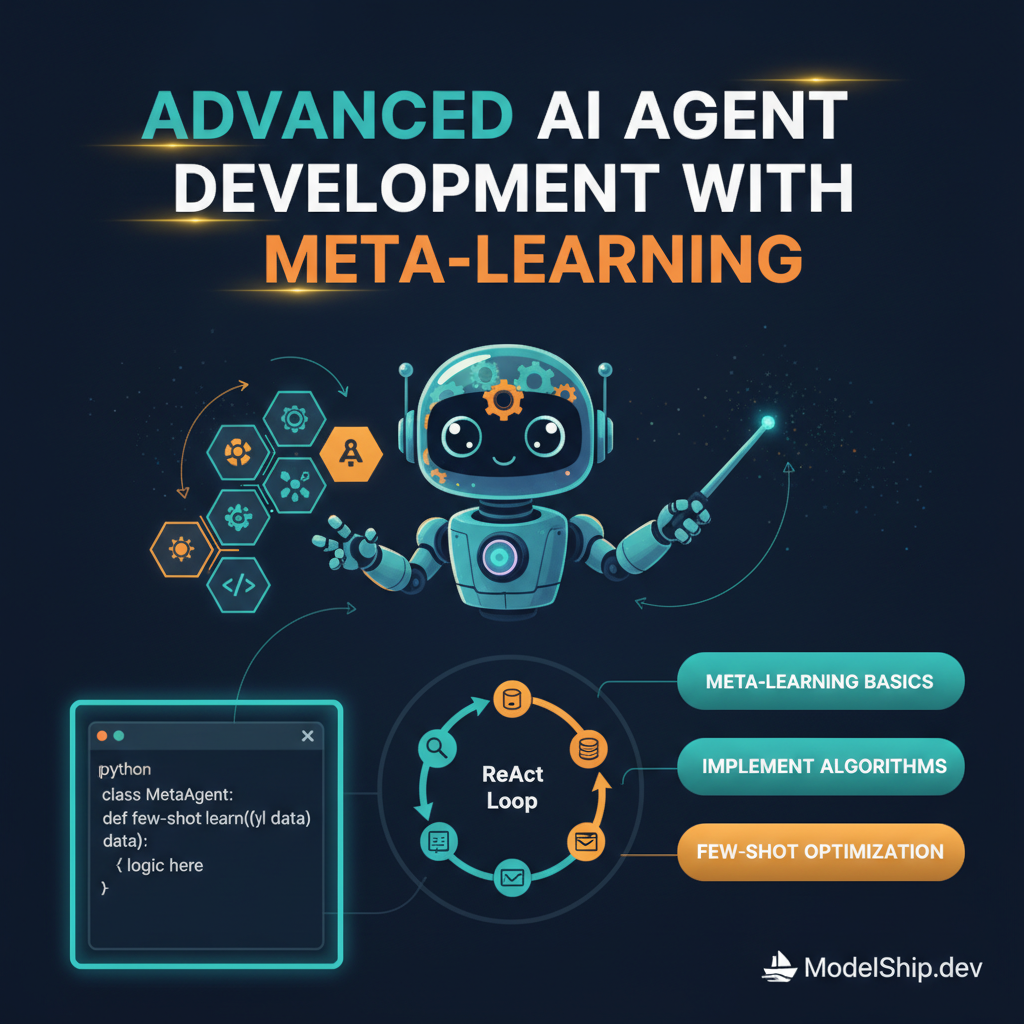
- Understand the basics of meta-learning and few-shot learning
- Learn how to implement meta-learning algorithms for AI agent development
- Discover the importance of few-shot learning in AI agent development
- Avoid common pitfalls in AI agent development, such as overfitting and underfitting
- Apply meta-learning and few-shot learning to real-world problems
Introduction to Meta-Learning
Meta-learning is a subfield of machine learning that focuses on developing algorithms that can learn how to learn. The key insight here is that meta-learning allows AI agents to learn how to learn, making them more efficient and effective in a wide range of tasks. What most tutorials miss is the importance of understanding the fundamentals of meta-learning before diving into implementation.
Types of Meta-Learning
There are several types of meta-learning, including few-shot learning, transfer learning, and multi-task learning. Few-shot learning is a type of meta-learning that involves learning from limited data, which is essential in many real-world applications.
Introduction to Few-Shot Learning
Few-shot learning is a type of meta-learning that involves learning from limited data. The key insight here is that few-shot learning enables AI agents to learn from a few examples, making them more efficient and effective in a wide range of tasks. What most tutorials miss is the importance of understanding the fundamentals of few-shot learning before diving into implementation.
Implementing Few-Shot Learning
Implementing few-shot learning involves using algorithms such as model-agnostic meta-learning (MAML) and receptive attention (RA). These algorithms enable AI agents to learn from limited data and adapt to new tasks quickly.
import torch
import torch.nn as nn
import torch.optim as optim

class MAML(nn.Module):
    def __init__(self):
        super(MAML, self).__init__()
        self.model = nn.Sequential(
            nn.Linear(784, 128),
            nn.ReLU(),
            nn.Linear(128, 10)
        )

    def forward(self, x):
        return self.model(x)

# Initialize the MAML model
model = MAML()

# Define the loss function and optimizer
criterion = nn.CrossEntropyLoss()
optimizer = optim.Adam(model.parameters(), lr=0.001)
Implementing Meta-Learning Algorithms
Implementing meta-learning algorithms involves using techniques such as gradient descent and stochastic gradient descent. The key insight here is that these techniques enable AI agents to learn how to learn, making them more efficient and effective in a wide range of tasks.
Avoiding Common Pitfalls
Avoiding common pitfalls in AI agent development involves understanding the importance of regularization and early stopping. Regularization involves adding a penalty term to the loss function to prevent overfitting, while early stopping involves stopping the training process when the performance of the AI agent on the validation set starts to degrade.
import torch
import torch.nn as nn
import torch.optim as optim

class MAML(nn.Module):
    def __init__(self):
        super(MAML, self).__init__()
        self.model = nn.Sequential(
            nn.Linear(784, 128),
            nn.ReLU(),
            nn.Linear(128, 10)
        )

    def forward(self, x):
        return self.model(x)

# Initialize the MAML model
model = MAML()

# Define the loss function and optimizer
criterion = nn.CrossEntropyLoss()
optimizer = optim.Adam(model.parameters(), lr=0.001)

# Add regularization to the loss function
regularization = 0.01
criterion = nn.CrossEntropyLoss() + regularization * model.parameters()

# Implement early stopping
early_stopping = 5
best_loss = float('inf')

for epoch in range(100):
    # Train the model
    model.train()
    for x, y in train_loader:
        optimizer.zero_grad()
        output = model(x)
        loss = criterion(output, y)
        loss.backward()
        optimizer.step()

    # Evaluate the model on the validation set
    model.eval()
    val_loss = 0
    with torch.no_grad():
        for x, y in val_loader:
            output = model(x)
            loss = criterion(output, y)
            val_loss += loss.item()

    # Check for early stopping
    if val_loss > best_loss:
        early_stopping -= 1
        if early_stopping == 0:
            break

    best_loss = val_loss
Real-World Applications of Meta-Learning
Meta-learning has many real-world applications, including developing AI agents with Scikit-Learn, introduction to multi-agent systems, and reinforcement learning agents. The key insight here is that meta-learning enables AI agents to learn how to learn, making them more efficient and effective in a wide range of tasks.
Developing AI Agents with Scikit-Learn
Developing AI agents with Scikit-Learn involves using techniques such as building custom AI agents with Python and Gym and deep Q-networks with PyTorch and Gym. These techniques enable AI agents to learn how to learn, making them more efficient and effective in a wide range of tasks.
Conclusion
In conclusion, meta-learning and few-shot learning are essential techniques for developing advanced AI agents. The key insight here is that these techniques enable AI agents to learn how to learn, making them more efficient and effective in a wide range of tasks. What most tutorials miss is the importance of understanding the fundamentals of meta-learning and few-shot learning before diving into implementation.
Answer: Meta-learning is a subfield of machine learning that focuses on developing algorithms that can learn how to learn, while few-shot learning is a type of meta-learning that involves learning from limited data.
Frequently Asked Questions
What is Meta-Learning?
Meta-learning is a subfield of machine learning that focuses on developing algorithms that can learn how to learn. The key insight here is that meta-learning enables AI agents to learn how to learn, making them more efficient and effective in a wide range of tasks.
What is Few-Shot Learning?
Few-shot learning is a type of meta-learning that involves learning from limited data. The key insight here is that few-shot learning enables AI agents to learn from a few examples, making them more efficient and effective in a wide range of tasks.
How Do I Implement Meta-Learning Algorithms?
Implementing meta-learning algorithms involves using techniques such as gradient descent and stochastic gradient descent. The key insight here is that these techniques enable AI agents to learn how to learn, making them more efficient and effective in a wide range of tasks.
PhD in NLP, now building AI products. I explain the 'why' behind AI systems so you can make better engineering decisions, not just copy-paste code.
More from Dr. Sarah Kim →Discussion
Loading comments…
Leave a comment
Related Articles