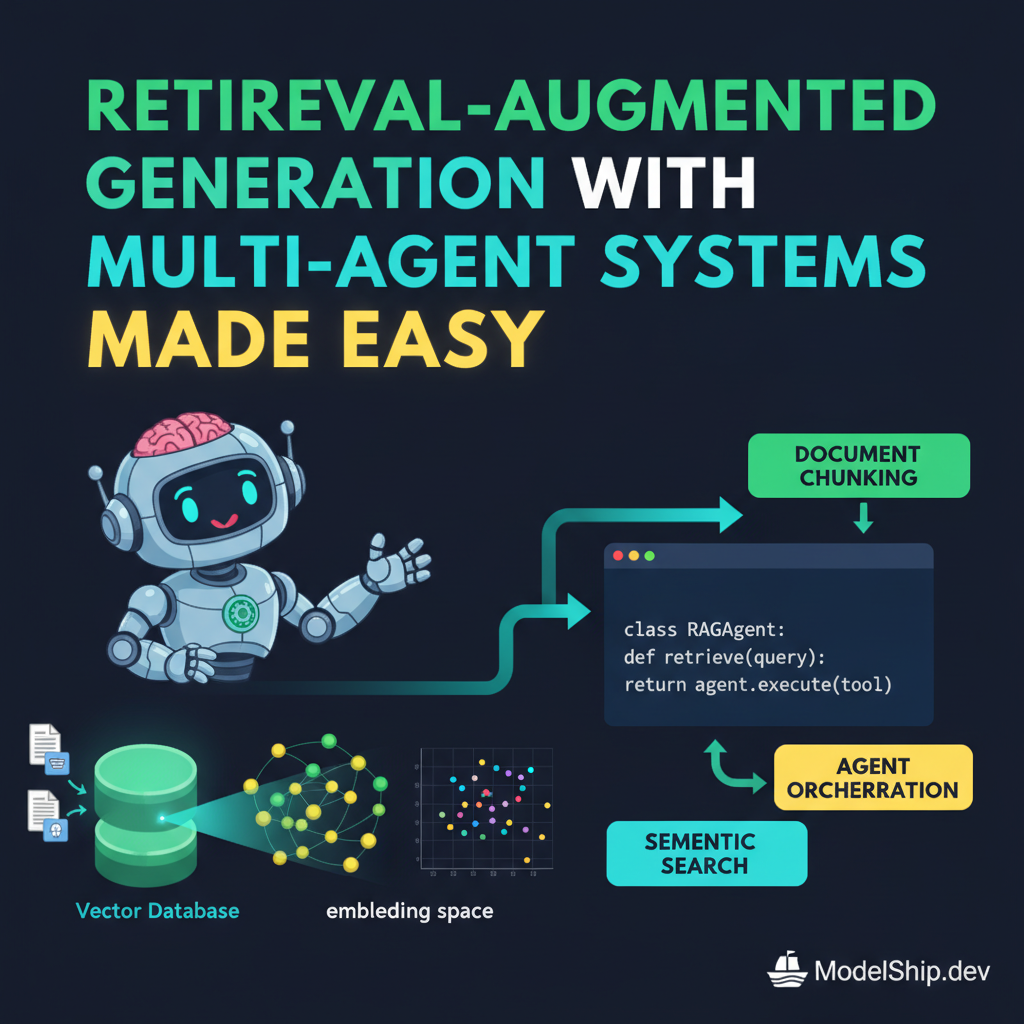
Retrieval-Augmented Generation with Multi-Agent Systems Made Easy
TL;DR
Think of it like a team effort - retrieval-augmented generation and multi-agent systems work together to create powerful AI models. I love this approach because it combines the strengths of both worlds, making it easier to build and train AI models. In this article, we'll break down the process into simple steps, so you can get started right away
Key Takeaways
- Understand the basics of retrieval-augmented generation and multi-agent systems
- Learn how to integrate these two concepts for enhanced AI capabilities
- Discover how to avoid common mistakes when implementing this approach
- Get hands-on experience with code examples and practical tips
- Apply this knowledge to real-world problems and improve your AI models
Introduction to Retrieval-Augmented Generation
Think of it like a library - retrieval-augmented generation is all about finding the right information to generate high-quality text. Don't worry if you're new to this - it's easier than you think. Here's a simple way to get started: imagine you're writing an article, and you need to find relevant information to include. That's basically what retrieval-augmented generation does, but instead of searching the internet, it uses a database of pre-existing text to generate new content.What is Retrieval-Augmented Generation?
Retrieval-augmented generation is a type of AI model that uses a combination of natural language processing and information retrieval to generate text. It's like having a personal research assistant that can find and summarize relevant information for you.Benefits of Retrieval-Augmented Generation
So, why use retrieval-augmented generation? For one, it can save you a lot of time and effort. Instead of spendings hours researching and writing, you can let the AI model do the work for you. Plus, it can help you generate high-quality content that's engaging and informative.Introduction to Multi-Agent Systems
Think of it like a team - multi-agent systems are all about agents working together to achieve a common goal. You don't need to be a programmer to understand this concept - it's actually quite straightforward. Here's a simple way to think about it: imagine you're working on a project with a team of people, each with their own strengths and weaknesses. That's basically what multi-agent systems do, but instead of people, it's AI agents working together.What are Multi-Agent Systems?
Multi-agent systems are a type of AI model that consists of multiple agents that interact and work together to achieve a common goal. It's like having a team of experts that can solve complex problems.Benefits of Multi-Agent Systems
So, why use multi-agent systems? For one, it can help you tackle complex problems that would be difficult or impossible for a single agent to solve. Plus, it can lead to more robust and flexible solutions.Integrating Retrieval-Augmented Generation with Multi-Agent Systems
Now that we've covered the basics of retrieval-augmented generation and multi-agent systems, let's talk about how to integrate them. Think of it like combining two powerful tools to create something even more powerful. Here's a simple way to get started: imagine you're using retrieval-augmented generation to generate text, and then using multi-agent systems to refine and improve the output.Step-by-Step Guide
Here's a step-by-step guide to integrating retrieval-augmented generation with multi-agent systems:
    # Import necessary libraries
    import numpy as np
    import torch
    import torch.nn as nn

    # Define the retrieval-augmented generation model
    class RAGModel(nn.Module):
        def __init__(self):
            super(RAGModel, self).__init__()
            self.encoder = nn.Sequential(
                nn.Embedding(10000, 128),
                nn.ReLU(),
                nn.Linear(128, 128)
            )
            self.decoder = nn.Sequential(
                nn.Embedding(10000, 128),
                nn.ReLU(),
                nn.Linear(128, 10000)
            )

        def forward(self, input_ids):
            encoded_input = self.encoder(input_ids)
            decoded_output = self.decoder(encoded_input)
            return decoded_output

    # Define the multi-agent system
    class MASModel(nn.Module):
        def __init__(self):
            super(MASModel, self).__init__()
            self.agents = nn.ModuleList([RAGModel() for _ in range(5)])

        def forward(self, input_ids):
            outputs = []
            for agent in self.agents:
                output = agent(input_ids)
                outputs.append(output)
            return torch.stack(outputs)
Training and Evaluating the Model
Now that we've defined the model, let's talk about how to train and evaluate it. Think of it like fine-tuning a machine - you need to adjust the parameters to get the best performance. Here's a simple way to get started: imagine you're using a dataset of text to train the model, and then evaluating its performance using metrics such as accuracy and F1 score.Training the Model
To train the model, you'll need a dataset of text. You can use a pre-existing dataset or create your own. Once you have the dataset, you can use a library like PyTorch to train the model.Evaluating the Model
To evaluate the model, you can use metrics such as accuracy and F1 score. You can also use techniques such as cross-validation to get a more accurate estimate of the model's performance.Real-World Applications
Now that we've covered the basics of integrating retrieval-augmented generation with multi-agent systems, let's talk about some real-world applications. Think of it like using a powerful tool to solve complex problems - you can apply this approach to a wide range of tasks, from text generation to decision-making.Text Generation
One of the most obvious applications of this approach is text generation. You can use retrieval-augmented generation to generate high-quality text, and then use multi-agent systems to refine and improve the output.Decision-Making
Another application of this approach is decision-making. You can use multi-agent systems to model complex decision-making scenarios, and then use retrieval-augmented generation to generate text that summarizes the results. For more information on RAG-based question answering, check out our previous article. You can also learn more about optimizing vector search and building hybrid RAG systems.Frequently Asked Questions
What is the difference between retrieval-augmented generation and traditional text generation?
Retrieval-augmented generation uses a database of pre-existing text to generate new content, whereas traditional text generation relies on machine learning algorithms to generate text from scratch.
Can I use multi-agent systems for tasks other than text generation?
Yes, multi-agent systems can be used for a wide range of tasks, from decision-making to game playing. The key is to define the agents and their interactions in a way that is suitable for the task at hand.
How do I train and evaluate a multi-agent system?
To train and evaluate a multi-agent system, you'll need to define the agents and their interactions, and then use a dataset of examples to train the system. You can use metrics such as accuracy and F1 score to evaluate the system's performance.
Conclusion
Integrating retrieval-augmented generation with multi-agent systems is a powerful approach to building AI models. By combining the strengths of both worlds, you can create models that are more robust, flexible, and accurate. Remember to train and evaluate the model carefully, and to avoid common mistakes such as not properly training the agents. With this approach, you can tackle complex problems and achieve state-of-the-art results. For more information on building production RAG pipelines, check out our previous article.I help everyday people understand and use AI tools without a tech degree. Former teacher turned content creator — I believe AI should be accessible to everyone.
More from Priya Patel →Discussion
Loading comments…
Leave a comment
Related Articles