Optimizing Vector Search with Quantization and Pruning
TL;DR
Here's the thing, when working with large vector datasets, optimizing search is crucial. In my experience, quantization and pruning can significantly improve query performance. This is the part most tutorials skip, so let me show you exactly how I do this. I'll cover the implementation details, gotchas, and things that bit me in production.
Key Takeaways
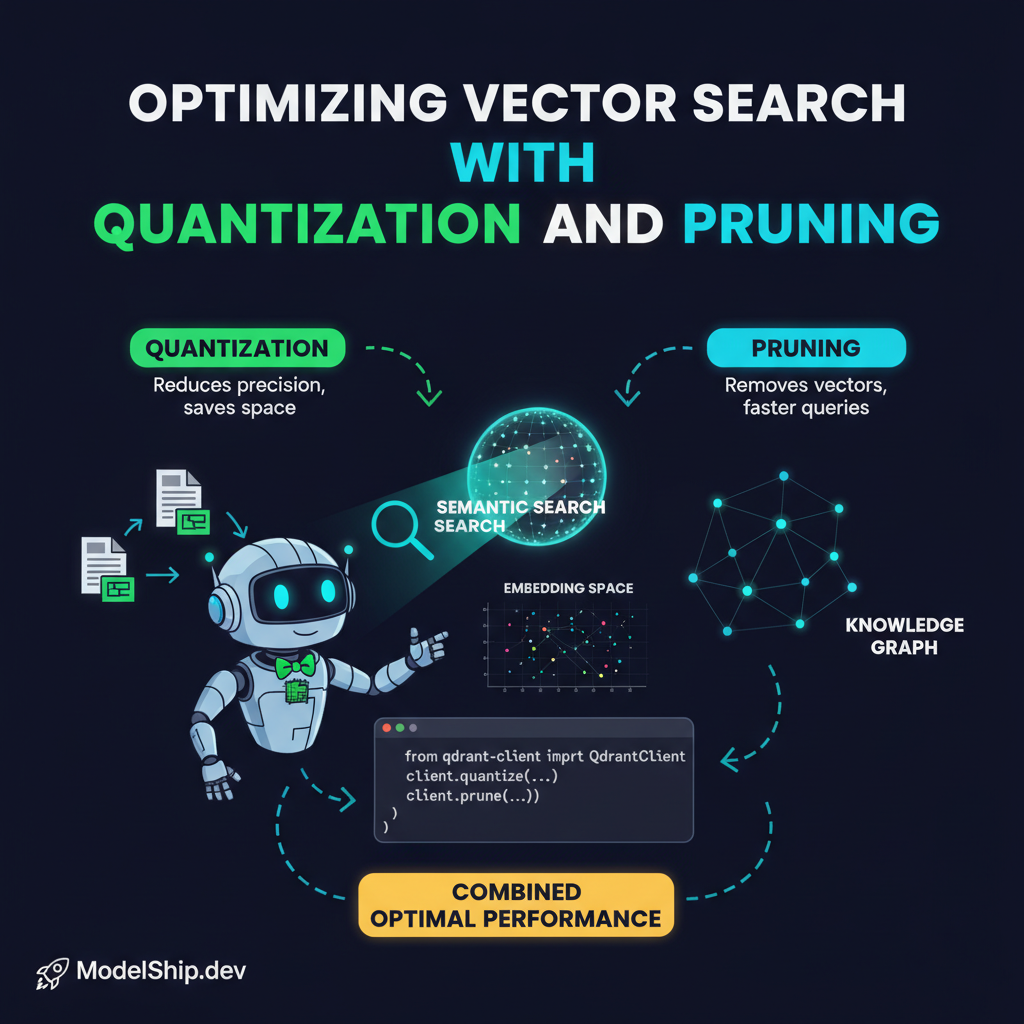
- Quantization reduces the precision of vector representations, resulting in significant storage savings and improved query performance
- Pruning techniques can be used to reduce the number of vectors in the search index, leading to faster query times
- Combining quantization and pruning can lead to optimal vector search performance
- Choosing the right quantization and pruning techniques depends on the specific use case and dataset
- Implementing these techniques in production requires careful consideration of trade-offs between accuracy, storage, and query performance
Introduction to Vector Search Optimization
Vector search is a critical component of many AI applications, including Hybrid RAG System with LangGraph and ElasticSearch and Building Production RAG Pipelines with Supabase pgvector. As the size of vector datasets grows, optimizing search becomes increasingly important. In this article, we'll explore how to optimize vector search using quantization and pruning techniques.
Quantization Techniques
What is Quantization?
Quantization reduces the precision of vector representations, resulting in significant storage savings and improved query performance. Here's an example of how to implement quantization using PyTorch:
import torch
import torch.nn as nn

class QuantizationModule(nn.Module):
    def __init__(self, num_bits):
        super(QuantizationModule, self).__init__()
        self.num_bits = num_bits

    def forward(self, x):
        # Quantize the input tensor
        x_quantized = torch.quantize_per_tensor(x, scale=1.0, zero_point=0, dtype=torch.qint8)
        return x_quantized

quantization_module = QuantizationModule(num_bits=8)
input_tensor = torch.randn(1, 128)
quantized_tensor = quantization_module(input_tensor)
Types of Quantization
There are several types of quantization, including uniform quantization, logarithmic quantization, and adaptive quantization. Each type has its own strengths and weaknesses, and choosing the right one depends on the specific use case and dataset.
Pruning Techniques
What is Pruning?
Pruning techniques can be used to reduce the number of vectors in the search index, leading to faster query times. Here's an example of how to implement pruning using scikit-learn:
from sklearn.decomposition import PCA

pca = PCA(n_components=0.95)
input_data = np.random.rand(100, 128)
pruned_data = pca.fit_transform(input_data)
Types of Pruning
There are several types of pruning, including PCA, t-SNE, and autoencoders. Each type has its own strengths and weaknesses, and choosing the right one depends on the specific use case and dataset.
Combining Quantization and Pruning
Combining quantization and pruning can lead to optimal vector search performance. Here's an example of how to implement a combined approach using PyTorch and scikit-learn:
import torch
import torch.nn as nn
from sklearn.decomposition import PCA

class CombinedModule(nn.Module):
    def __init__(self, num_bits, n_components):
        super(CombinedModule, self).__init__()
        self.num_bits = num_bits
        self.n_components = n_components
        self.quantization_module = QuantizationModule(num_bits)
        self.pca = PCA(n_components=n_components)

    def forward(self, x):
        # Quantize the input tensor
        x_quantized = self.quantization_module(x)
        # Prune the quantized tensor using PCA
        x_pruned = self.pca.fit_transform(x_quantized)
        return x_pruned

combined_module = CombinedModule(num_bits=8, n_components=0.95)
input_tensor = torch.randn(1, 128)
pruned_tensor = combined_module(input_tensor)
Frequently Asked Questions
What is the difference between quantization and pruning?
Quantization reduces the precision of vector representations, while pruning reduces the number of vectors in the search index.
How do I choose the right quantization and pruning techniques for my use case?
Choosing the right techniques depends on the specific use case and dataset. Experiment with different techniques and evaluate their impact on accuracy, storage, and query performance.
Can I use quantization and pruning with other AI applications, such as Building a Containerized AI Dev Environment?
Yes, quantization and pruning can be used with other AI applications, including computer vision and natural language processing.
Conclusion
In conclusion, optimizing vector search with quantization and pruning techniques can lead to significant improvements in query performance and storage savings. By understanding the different types of quantization and pruning, and how to combine them, you can create efficient and effective vector search systems. Remember to consider the trade-offs between accuracy, storage, and query performance when implementing these techniques in production. For more information on AI model deployment, check out Kubeflow for AI Model Deployment on Kubernetes and Deploying AI Models to Edge Devices with TensorFlow Lite.
7 years building production AI systems. I write about the stuff that actually works in the real world — practical code, real architectures, zero fluff.
More from Alex Chen →Discussion
Loading comments…
Leave a comment
Related Articles