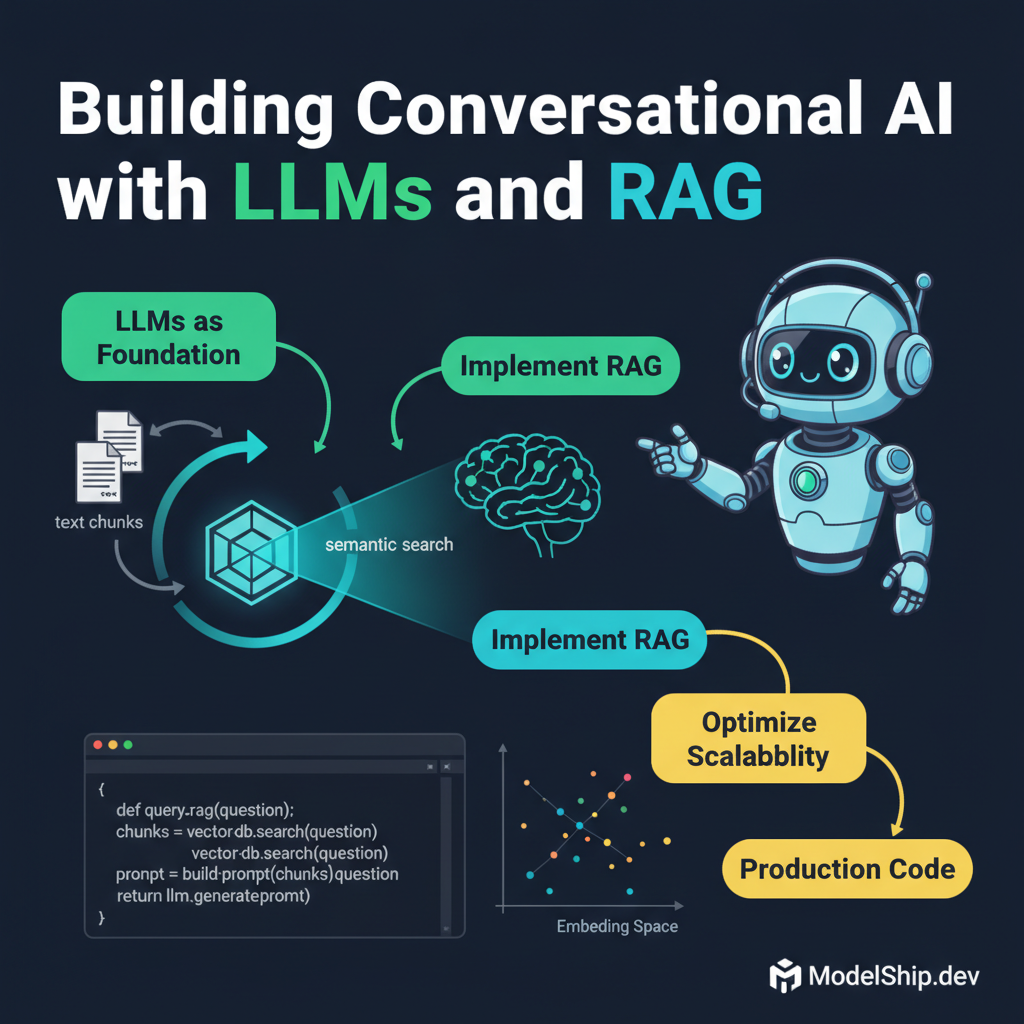
Hybrid Search RAG: Unifying Symbolic and Connectionist AI
TL;DR
The key insight here is that hybrid approaches can leverage the strengths of both symbolic and connectionist AI. By combining these paradigms, we can create more robust and flexible search systems. What most tutorials miss is the importance of understanding the underlying principles of both symbolic and connectionist AI before attempting to integrate them. In this article, we'll break down the fundamentals of Hybrid Search RAG and provide a step-by-step guide to implementing this powerful technology.
Key Takeaways
- Understand the principles of symbolic and connectionist AI before integrating them
- Learn how to combine vector search and knowledge graph querying for more effective search capabilities
- Implement Hybrid Search RAG using popular libraries and frameworks
- Optimize your search system for efficiency and scalability
- Avoid common pitfalls and misconceptions when working with hybrid AI systems
Introduction to Hybrid Search RAG
The key insight here is that hybrid approaches can leverage the strengths of both symbolic and connectionist AI. By combining these paradigms, we can create more robust and flexible search systems. In this article, we'll explore the fundamentals of Hybrid Search RAG and provide a step-by-step guide to implementing this powerful technology.
Symbolic AI and Connectionist AI: A Primer
Before we dive into Hybrid Search RAG, it's essential to understand the underlying principles of both symbolic and connectionist AI. Symbolic AI relies on rules and knowledge graphs to reason about the world, while connectionist AI uses neural networks and vector search to identify patterns and relationships.
Symbolic AI: Rules and Knowledge Graphs
Symbolic AI is based on the idea that intelligence can be represented using symbols and rules. This approach has been successful in many areas, including expert systems and natural language processing. For example, conversational AI often relies on symbolic AI to understand and respond to user input.
Connectionist AI: Neural Networks and Vector Search
Connectionist AI, on the other hand, uses neural networks and vector search to identify patterns and relationships in data. This approach has been successful in many areas, including computer vision and natural language processing. For example, efficient indexing for vector search is a critical component of many connectionist AI systems.
Hybrid Search RAG: Combining Symbolic and Connectionist AI
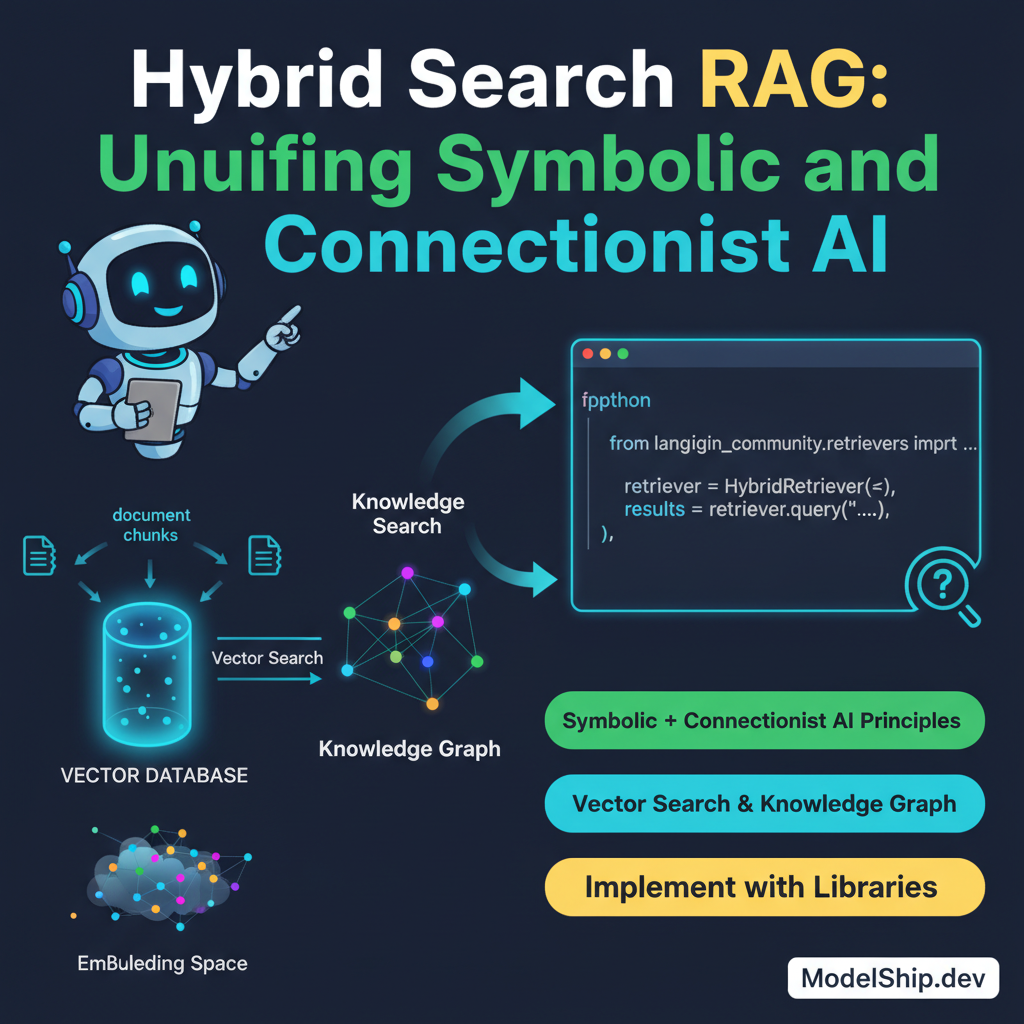
Hybrid Search RAG combines the strengths of both symbolic and connectionist AI to create a more robust and flexible search system. By integrating vector search and knowledge graph querying, we can create a search system that is both efficient and effective.
Vector Search and Knowledge Graph Querying
Vector search is a critical component of many connectionist AI systems. By using vector search, we can efficiently identify patterns and relationships in large datasets. Knowledge graph querying, on the other hand, is a critical component of many symbolic AI systems. By using knowledge graph querying, we can reason about the world and identify relationships between entities.
Implementing Hybrid Search RAG
Implementing Hybrid Search RAG requires a combination of symbolic and connectionist AI techniques. We'll use popular libraries and frameworks, such as LLaMA and LangChain, to create a hybrid search system that combines vector search and knowledge graph querying.
import numpy as np
from langchain import LLM
from llama import LLaMA

# Define the knowledge graph
kg = ...

# Define the vector search index
index = ...

# Define the hybrid search function
def hybrid_search(query):
    # Use vector search to identify patterns and relationships
    results = index.search(query)
    # Use knowledge graph querying to reason about the world
    results = kg.query(results)
    return results
Optimizing Hybrid Search RAG
Optimizing Hybrid Search RAG requires a combination of techniques, including indexing, caching, and query optimization. By using these techniques, we can create a search system that is both efficient and scalable.
Indexing and Caching
Indexing and caching are critical components of many search systems. By using indexing and caching, we can reduce the latency and increase the throughput of our search system.
Query Optimization
Query optimization is a critical component of many search systems. By using query optimization, we can reduce the computational complexity and increase the accuracy of our search results.
Common Misconceptions and Pitfalls
There are several common misconceptions and pitfalls when working with Hybrid Search RAG. One common misconception is that hybrid approaches are always more complex and difficult to implement than traditional approaches.
Frequently Asked Questions
What is Hybrid Search RAG?
Hybrid Search RAG is a search system that combines the strengths of both symbolic and connectionist AI. By integrating vector search and knowledge graph querying, we can create a search system that is both efficient and effective.
How does Hybrid Search RAG work?
Hybrid Search RAG works by using vector search to identify patterns and relationships in large datasets, and then using knowledge graph querying to reason about the world and identify relationships between entities.
What are the advantages of using Hybrid Search RAG?
The advantages of using Hybrid Search RAG are that it can leverage the strengths of both symbolic and connectionist AI, creating a more robust and flexible search system. Additionally, Hybrid Search RAG can be more efficient and scalable than traditional search systems.
Conclusion
In conclusion, Hybrid Search RAG is a powerful technology that combines the strengths of both symbolic and connectionist AI. By integrating vector search and knowledge graph querying, we can create a search system that is both efficient and effective. By following the principles and techniques outlined in this article, we can create a hybrid search system that is both fast and accurate. For more information on efficient similarity search in RAG with embeddings and vector database comparison for RAG and search, please refer to our previous articles.
PhD in NLP, now building AI products. I explain the 'why' behind AI systems so you can make better engineering decisions, not just copy-paste code.
More from Dr. Sarah Kim →Discussion
Loading comments…
Leave a comment
Related Articles